












Depression Guide: Helping People Daily
TweetThis will pass, it's only temporary. Depression is a listed mental disorder which includes altered mood; it may occur daily associated with diminished interest or pleasure in most or all of the activities.
The Road to Recovery from Depression is long, winding and full of surprises. We need help from all our resources such as friends, family, support groups, caregivers, etc. Then there are things which we can do on our own. These resources on self help tips can be the saviour in the time of seclusion. It can lighten the flame when the times are rough.
Few tips to keep your depression in control
- Do not be stressful and try to avoid stress as much as possible.
- If you are on Meds, take appropriate dosage in Routine
- Put yourself first. Make your life and well being the first priority. This will make you find the life flow that you can control and maintain.
- Be psychologically flexible - You need to adapt to the constantly changing circumstances.
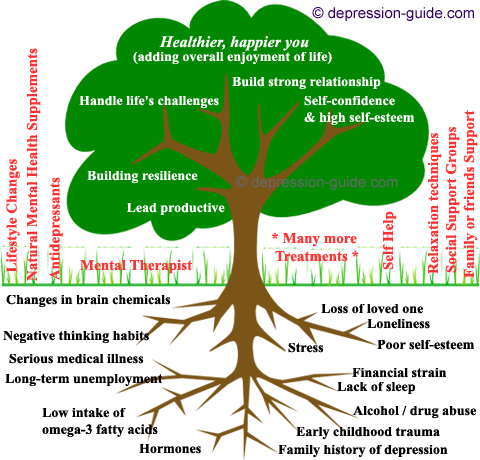
Depression is like a tree that has many roots!!
Depression Pain and Recovery Stories
Depression gets the best of us - I was just dealing with the Suicidal thoughts and not doing anything about it. Then I started burning myself quite often. I liked the pain. It got me away from everything for a while. I would lock myself in my room and listen to music or go on Facebook all day. Then in the beginning of January I started cutting. I was just cutting the top of my hands not that bad. Then I started cutting my arm a lot really badly. I couldn't stop. Read More
The Secret Life of Depression and Anxiety - My name is Jasmine and I am 21 years old. I'm a really shy person, who always seem to have a mean face but once you get to know me I’m outgoing, goofy, & fun to be around. My passion right at this moment is cooking, I want to be a pastry chef & soon own a business. What started my depression was my mom's ex-boyfriend he molested me between the ages of 9-10. Read More
W H A T ' S N E W
 Communication Quiz - Do you relate to others assertively, or do you cause unnecessary additional conflict and stress. Check with this quiz -
Read More Communication Quiz - Do you relate to others assertively, or do you cause unnecessary additional conflict and stress. Check with this quiz -
Read More |
 Ways to Overcome Self-Doubt - The Impostor Phenomenon describes the experience of feeling like a phony, unable to internalize success...Read More Ways to Overcome Self-Doubt - The Impostor Phenomenon describes the experience of feeling like a phony, unable to internalize success...Read More |
|
 Parental Alienation: A risk factor for depression - The family dynamic in which one parent engages in many of the 17 primary parental alienation strategies... Read More Parental Alienation: A risk factor for depression - The family dynamic in which one parent engages in many of the 17 primary parental alienation strategies... Read More |
 Complex Relational Trauma - Relational trauma pertains to a “violation of human connection" resulting in attachment injuries...Read More Complex Relational Trauma - Relational trauma pertains to a “violation of human connection" resulting in attachment injuries...Read More |
|
 Anger quiz - I got angry on almost all the things earlier and had tough time. It took me years to identify my Anger as a problem which can be solved. Take this quiz. Read More Anger quiz - I got angry on almost all the things earlier and had tough time. It took me years to identify my Anger as a problem which can be solved. Take this quiz. Read More |
 Dyslexia Test - Know about the learning profile of a member of your family or a student using this simple quiz. Read More Dyslexia Test - Know about the learning profile of a member of your family or a student using this simple quiz. Read More |

Do you like this Story?
| Tweet |
|
|
Conversation
depression-guide User | on Twitter Tweets by @depressguide Most Popular | on FacebookStay Connected with DG





Stress Management Leaflet
 |
|
 Self Help Leaflets Take the help of our self help leaflets or booklets. |
 The DG Magazine All about living with depression |

Find a Therapist
Depression-Guide profiles for therapists, psychiatrists, support groups and treatment centers.
Are you a therapist? Get Listed Today
Mental Health
- ADHD
- GAD
- ODD
- Dementia
- Schizophrenia
- Mutism
- Anxiety
- Learning Disability
- Sexual Disorders
- Personality
- Child Psychiatry
- Neuropsychiatry
- Psychiatry
- Brain Disorders
- Epilepsy Seizure
- Asperger's syndrome
- Autism
- Sleeping Disorder
- Eating Disorder
- Somatoform Disorders
- PMDD
- Factitious Disorders
- Cognitive Disorders
- Trauma
- Disruptive Behavior Disorders
- Psychotic Disorder
- Dissociative Disorders
- Psychiatric Disorder
- OCD
- Alphabetical List of Disorders